Published
- 5 min read
Defeating Ants and Bees: Pest Control for Oriole Feeders
Defeating Ants and Bees: Pest Control for Oriole Feeders
If you build an Oriole feeding station, the birds will come. Unfortunately, so will every ant, bee, and wasp in a 50-yard radius.
Orioles require a diet of pure sugar—grape jelly, sliced oranges, and nectar. To insects, your carefully curated bird feeder is an all-you-can-eat dessert buffet. This is more than just a minor annoyance; it is a major deterrent for the birds. Orioles are notoriously skittish. If a feeder is swarming with aggressive yellow jackets, or if the jelly cup is a writhing mass of black ants, the Oriole will simply fly away and find food elsewhere.
As a backyard birding expert, the most common complaint I receive is, “How do I stop the bugs from eating all the jelly?” The good news is that you do not need toxic chemical sprays to reclaim your feeders. By using physical barriers, behavioral tricks, and specialized accessories from Amazon, you can create a pest-free zone for your favorite birds.
1. The Ant Invasion: Winning with Moats
Ants are relentless. If your feeder is hanging from a shepherd’s hook or a tree branch, scout ants will climb the pole, find the sugar, and leave a pheromone trail for the rest of the colony. Within an hour, your jelly will be ruined.
The Ultimate Weapon: The Ant Moat
The absolute best way to stop ants is a physical water barrier. Ants cannot swim.
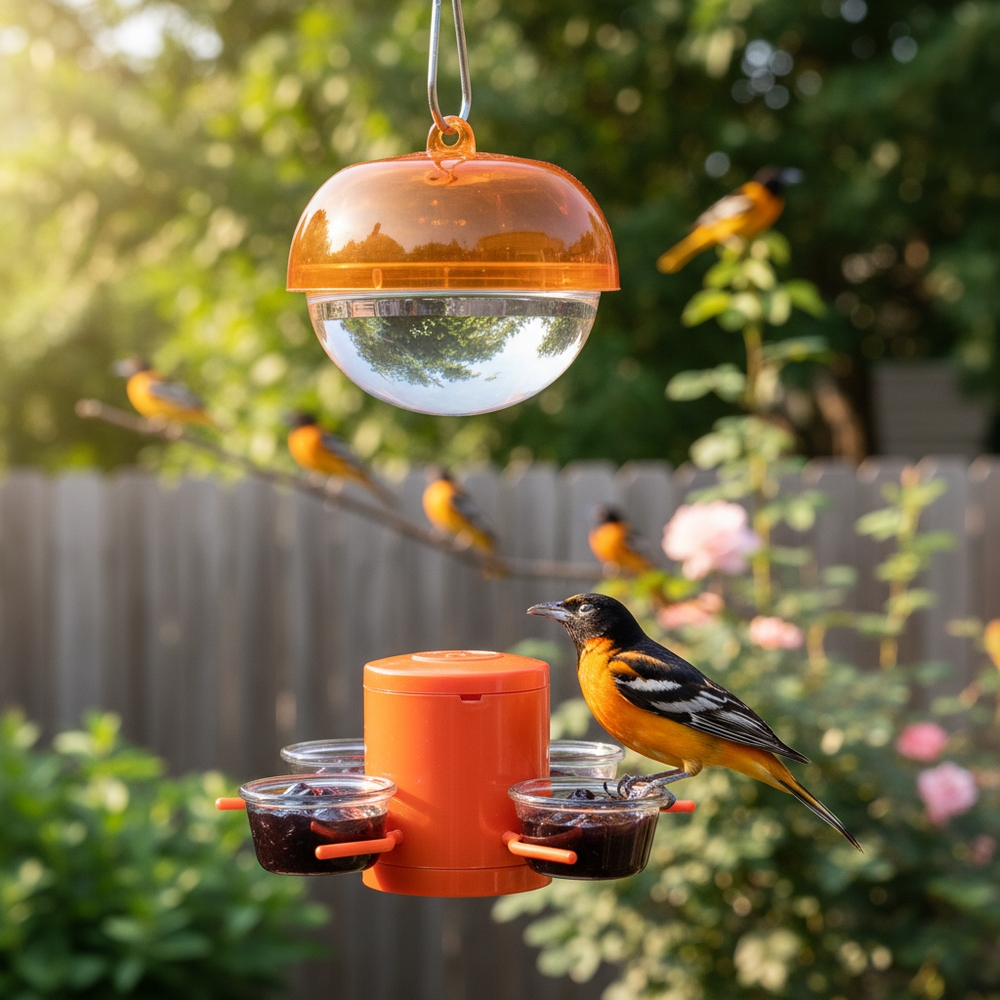
- How it works: An ant moat is a small cup shaped like an umbrella that hangs above your feeder. You fill the cup with plain tap water. The ant climbs down the hook, hits the water, and is trapped. They cannot cross the “moat” to reach the feeder below.
- The Golden Rule: Never put oil, vaseline, or poison in the moat. Birds occasionally drink from these moats. Plain water is 100% effective.
- Affiliate Pick: Trap-It Original Ant Moat (Orange). The bright orange color doubles as an extra visual attractant for the Orioles.
Important Note: Many premium Oriole feeders (like the Songbird Essentials Ultimate) come with a small ant moat built into the top. Ensure you keep it filled with water daily, as it evaporates quickly in the summer sun.
2. The Bee and Wasp Problem: Deterrence and Redirection
While ants crawl, bees and wasps fly, making them much harder to defeat. They are attracted to the same sweet nectar and jelly the Orioles are.
Strategy 1: The “Cleanliness” Defense
Bees and wasps have an incredible sense of smell. If your feeder is dripping nectar onto the grass below, or if you smeared jelly on the outside of the cup while refilling it, the wasps will find it.
- The Fix: Wipe down the outside of your feeders with a damp cloth every single time you refill them. If your nectar feeder is leaking, replace it immediately. A perfectly sealed, clean feeder emits significantly less odor.
Strategy 2: Nectar Port Bee Guards
Unlike hummingbirds and orioles, bees have short “tongues.” They cannot reach deep into a feeder.
- The Fix: Look for Oriole nectar feeders equipped with “Bee Guards.” These are small plastic cages or mesh covers over the feeding ports. They allow the long beak of an Oriole to reach the nectar but keep the physical surface of the liquid out of reach of a wasp.
Strategy 3: The “Decoy” Feeder
If a wasp colony has already “claimed” your Oriole feeder, it is very difficult to break their habit. The best strategy is a decoy.
- The Fix: Take a small, shallow dish and fill it with a mixture of sugar water that is sweeter than your Oriole nectar (e.g., 1 part sugar to 2 parts water). Place this dish about 15 feet away from your bird feeder, ideally in a bright, sunny spot (wasps love heat). The wasps will abandon the bird feeder in favor of the sweeter, easier-to-access decoy dish.
3. The Mammal Menace: Squirrels and Raccoons
Bugs aren’t the only creatures that love grape jelly. Squirrels and raccoons will happily empty your glass cups overnight.
- The Baffle Defense: If your feeder is mounted on a pole or a shepherd’s hook, you must install a squirrel baffle. This is a large metal or plastic cone mounted on the pole below the feeder. When a squirrel tries to climb the pole, they hit the cone and cannot bypass it.
- Pole Placement: Baffles only work if the squirrel cannot jump over them from a nearby tree or fence. Ensure your pole is at least 10 feet away from any jumping launchpad.
- Affiliate Pick: Audubon Wrap-Around Squirrel Baffle
Conclusion
Feeding Orioles is a rewarding hobby, but it requires defending your buffet from uninvited guests. By deploying a bright orange water moat for the ants, maintaining strict cleanliness and using bee guards for the wasps, and installing a heavy-duty baffle for the squirrels, you can ensure that 100% of your expensive jelly and nectar goes to the beautiful birds you are trying to attract. Arm your feeding station today and watch the Orioles return in peace.