Published
- 5 min read
The Bee Takeover: How to Reclaim Your Jelly Feeder from Yellow Jackets
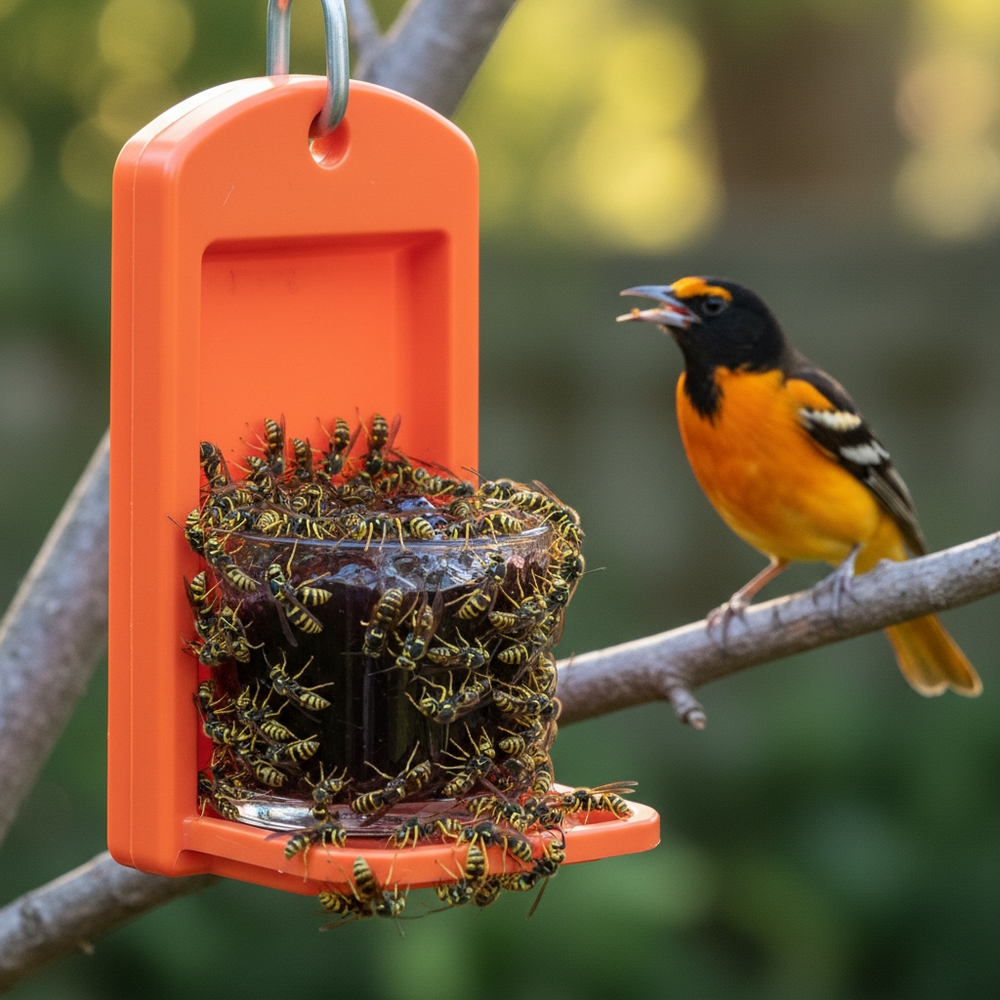
The Bee Takeover: How to Reclaim Your Jelly Feeder from Yellow Jackets
It happens every summer. You fill your glass cups with fresh grape jelly, hang the feeder on your shepherd’s hook, and retreat to the porch to wait for the Orioles. But before the first orange feather appears, a scout yellow jacket finds the sugar. Within an hour, your beautiful bird feeder has become a writhing, buzzing mass of aggressive bees and wasps.
When this happens, the Orioles will completely abandon the station. They are skittish birds, and they will not risk getting stung on the beak to fight a wasp for a mouthful of jelly.
As a backyard birder, a “Bee Takeover” is incredibly frustrating. Your instinct might be to grab a can of chemical wasp spray, but you must never spray pesticides near a bird feeder. The residue is highly toxic to birds.
To win back your feeding station, you must outsmart the bees using biology and behavior. In this expert guide, I will share the top non-toxic strategies for reclaiming your jelly feeder.
1. The Strategy of Cleanliness (The Odor Factor)
Bees and wasps have a sense of smell that rivals a bloodhound. If your feeder smells like sticky, fermented fruit, they will find it from a mile away.
- The Spill Problem: When you refill the jelly cups, it is almost impossible not to get a little smear of jelly on the outside rim of the glass or on the wood/plastic frame of the feeder. To a wasp, that tiny smear is an invitation.
- The Fix: You must become meticulous. Every time you fill the feeder, take a damp cloth and wipe down the entire exterior of the feeder, focusing heavily on the rims of the jelly cups and the nectar ports.
- The Nectar Drip: If you have a nectar feeder hanging nearby, check it for leaks. A single drop of nectar on the grass below will attract a swarm. If your feeder drips when the wind blows, replace it immediately.
2. The “Decoy” Feeder Technique
If a colony of yellow jackets has already memorized the location of your Oriole feeder, it is very difficult to break their habit. The most effective strategy is a “Bait and Switch.”
- The Decoy: Take a small, shallow dish (a cheap plastic saucer works perfectly). Fill it with a mixture of grape jelly and sugar water that is significantly sweeter than what you feed the Orioles.
- The Placement: Move your Oriole feeder indoors for 24 hours. Place the Decoy dish exactly where the Oriole feeder used to hang. Let the wasps feast on the decoy.
- The Switch: After two days, slowly move the Decoy dish 5 feet away from the original spot. The next day, move it another 5 feet. Continue moving it until the Decoy is 20-30 feet away, ideally in a hot, sunny corner of the yard (wasps love heat).
- The Return: Once the wasps are trained to visit the Decoy in the sunny corner, hang your freshly cleaned Oriole feeder back in its original spot (which should be in the shade).
3. The Power of “Bee Guards” on Nectar Feeders
If the bees are attacking your liquid nectar (rather than the jelly), you have a hardware problem.
- The Biology: Orioles have long beaks and long tongues. Bees and wasps have relatively short feeding apparatuses.
- The Hardware Solution: You must buy an Oriole nectar feeder equipped with Bee Guards. These are small plastic cages or mesh covers that sit over the feeding ports.
- How it works: The Oriole can easily stick its long beak through the cage to reach the nectar below. However, the wasp cannot fit through the cage, and the liquid is kept just out of reach of its tongue. Frustrated, the wasp will eventually leave.
- Affiliate Pick: First Nature 32-ounce Oriole Feeder (with Bee Guards)
4. The Temporary Takedown
If you live in an area experiencing a severe yellow jacket bloom in late July or August, sometimes the only way to win is to temporarily retreat.
- The Takedown: If the decoy method fails and the swarm is aggressive, take all your jelly and nectar feeders down for 3 to 4 full days.
- The Result: Wasps are opportunistic foragers. If a food source completely disappears for several days, they will stop sending scouts and move on to a neighbor’s yard or a natural food source.
- The Oriole Impact: Yes, your Orioles will be confused, but remember that by mid-summer, their diet is shifting toward insects anyway. When you re-hang the meticulously clean feeders 4 days later, the Orioles will find them again, but the wasps will have forgotten them.
Conclusion
A bee takeover can ruin your morning birdwatching, but it is not a permanent defeat. By maintaining aggressive cleanliness, utilizing the Decoy method to redirect the swarm, and investing in feeders with physical bee guards, you can protect your feeding station without resorting to harmful chemicals. Take back your backyard and let the Orioles dine in peace!