Published
- 4 min read
Baltimore vs. Orchard Orioles: How to Identify Your Backyard Visitors
Baltimore vs. Orchard Orioles: How to Identify Your Backyard Visitors
When a flash of bright, vibrant color darts across your backyard and lands on your jelly feeder, it’s easy to immediately shout, “Look, a Baltimore Oriole!” For many people in the eastern and midwestern United States, the Baltimore Oriole is the only species they know by name.
However, if you look closely, you might realize that the bird at your feeder isn’t flaming orange at all—it might be a deep, rich, burnt rust color. If so, you are likely hosting an Orchard Oriole, a slightly smaller, more elusive, but equally fascinating backyard visitor.
As a backyard birder, learning to identify the specific species visiting your station adds a deeply rewarding layer to the hobby. In this guide, I will break down the key visual differences, vocalizations, and behavioral traits that will help you distinguish between the famous Baltimore Oriole and the beautiful Orchard Oriole.
1. The Male Plumage: Flaming Orange vs. Burnt Chestnut
The easiest way to tell the two species apart is by looking at the adult males.
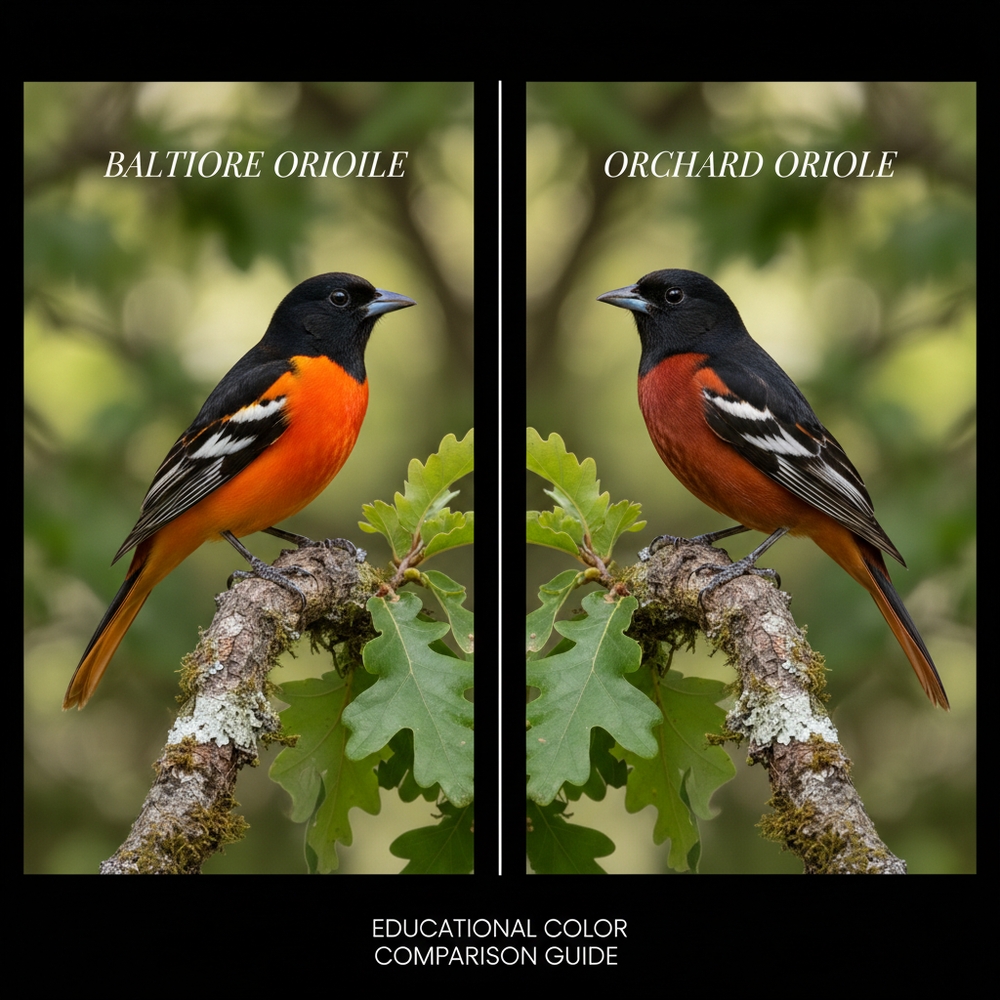
The Adult Male Baltimore Oriole
This is the iconic “Halloween bird.”
- The Color: A brilliant, eye-popping, bright fiery orange on the breast, belly, and rump.
- The Head: A solid, jet-black “hood” covering the entire head, throat, and upper back.
- The Wings: Black wings with a bold, distinct single white wing bar.
The Adult Male Orchard Oriole
The Orchard Oriole is the smallest species of Oriole in North America, and its coloring reflects a more muted, autumnal palette.
- The Color: Instead of bright orange, the breast and belly are a deep, rich chestnut, brick-red, or burnt rust color.
- The Head: Like the Baltimore, it has a solid black hood.
- The Wings: Black wings, but typically showing narrower, less prominent white wing bars.
2. The Female Challenge: Yellows and Olives
Identifying female and juvenile Orioles is significantly harder. Both female Baltimore and Orchard Orioles share a similar yellowish-olive palette, serving as camouflage while nesting.
The Female Baltimore Oriole
- The Color: They tend to be a brighter, yellowish-orange on the breast, with a brownish-olive back. Older females often develop black feathers on their heads, mimicking the male’s hood.
- Size: Noticeably larger and bulkier than the Orchard female.
The Female Orchard Oriole
- The Color: A distinct greenish-yellow overall. They look much more like a large warbler or a female goldfinch. They lack the orange undertones of the Baltimore female.
- First-Year Males: Juvenile male Orchard Orioles look identical to the greenish-yellow females, but with one key difference: they have a distinct black “bib” or patch on their throat.
3. Habitat and Behavior Differences
While both birds love a good jelly feeder, they have slightly different preferences when it comes to nesting and hanging out in your yard.
- The High-Canopy Baltimore: Baltimore Orioles love tall, mature deciduous trees (like Elm, Maple, and Cottonwood). They prefer to build their famous hanging pendulum nests high up at the very ends of drooping branches.
- The Mid-Level Orchard: True to their name, Orchard Orioles prefer shorter trees, orchards, shrublands, and the edges of woods. They will often nest much lower to the ground than Baltimores and are generally more tolerant of nesting closer to other birds.
4. Equipping Yourself for Identification
To truly appreciate the subtle differences in plumage—especially when trying to identify a fast-moving female high in the canopy—you need the right gear.
A standard pair of cheap, compact binoculars won’t gather enough light to show true colors in the shade of a tree. You need a pair with an 8x magnification and a 42mm objective lens (8x42). This provides the perfect balance of wide field-of-view and bright, color-accurate light gathering.
- Affiliate Pick: Nikon ProStaff 3S 8x42 Binoculars. These are widely considered the best entry-level premium binoculars for backyard birders.
- The Field Guide: To cross-reference your sightings, keep a definitive field guide near the window.
- Affiliate Pick: The Sibley Guide to Birds. The illustrations clearly highlight the differences between juvenile, female, and male plumages for both species.
Conclusion
Next time you see a dark and colorful bird land on your jelly feeder, don’t just assume it’s a Baltimore Oriole. Grab your binoculars and look closely at the breast color. Is it neon orange, or is it a deep, rich chestnut? By learning to identify the subtle differences between the Baltimore and Orchard species, you elevate your backyard birding from casual observation to true citizen science.