Published
- 5 min read
The Best Cameras for Backyard Bird Photography: Capturing Orioles
The Best Cameras for Backyard Bird Photography: Capturing Orioles
You’ve done the hard work. You’ve hung the perfect orange feeder, mixed the ideal nectar ratio, and finally, a magnificent male Baltimore Oriole has landed in your yard. He sits there in all his flaming-orange glory against the spring foliage. You slowly pull out your smartphone, pinch the screen to zoom in as far as it goes, and snap a photo.
The result? A blurry, pixelated, orange blob that looks more like a carrot than a bird.
Smartphones are incredible tools, but they rely on digital zoom, which destroys image quality. If you want to capture the true, crisp detail of a wild Oriole—the fine black feathers on the hood, the glint in its eye, the sharp beak dipping into the jelly—you need a dedicated camera with a true optical zoom.
In this guide, I will break down the essential features you need for backyard bird photography and review the best, most accessible cameras on Amazon for capturing your feathered visitors.
1. What Makes a “Birding” Camera?
You do not need a $5,000 professional sports photography rig to take a great photo of a bird at your feeder. However, you do need a camera that excels in two specific areas: Reach (Zoom) and Speed (Autofocus).
The “Reach” (Focal Length)
Birds are small and skittish. You need a lens that acts like a telescope. In photography terms, you want a focal length of at least 300mm to 600mm.
- The Problem with DSLRs: A 600mm lens for a professional DSLR camera can cost upwards of $2,000 and weigh 5 pounds.
- The Solution: For backyard birders, the “Superzoom” or “Bridge” camera is the holy grail. These cameras have a massive, built-in zoom lens that cannot be detached, providing incredible reach in a compact, affordable package.
The “Speed” (Autofocus and Burst Mode)
Orioles do not pose. They dart, twitch, and fly away in milliseconds.
- Your camera needs fast, continuous autofocus to lock onto the bird.
- You need a “Burst Mode” of at least 5 frames per second (fps). You hold the button down, take 10 photos in two seconds, and pick the one where the bird’s eyes are open.
2. The Best Superzoom Cameras on Amazon
Here are the top three “Bridge” cameras that offer the massive zoom needed for birding without the complexity of interchangeable lenses.
1. The Ultimate All-Rounder: Panasonic LUMIX FZ80
If you want the best balance of price, performance, and weight, this is it.
- Why it wins: It features a staggering 60x optical zoom (equivalent to 20-1200mm). This means you can take a wide shot of your entire yard, and then zoom in close enough to fill the frame with an Oriole sitting 40 feet away. It shoots 4K video and has an incredibly fast autofocus system.
- Get it on Amazon: Panasonic LUMIX FZ80 4K Digital Camera
2. The Premium Choice: Sony Cyber-Shot RX10 IV
If you have a higher budget and demand professional-level image quality, Sony is the leader.
- Why it wins: While the zoom is slightly less than the Lumix (25x, up to 600mm), it uses a much larger 1-inch sensor and a high-end Zeiss lens. This means your photos will be significantly sharper, better in low light, and have that beautiful “blurred background” (bokeh) that makes the bird pop. Its autofocus is arguably the fastest in its class.
- Get it on Amazon: Sony Cyber-Shot RX10 IV
3. The Budget Spotter: Canon PowerShot SX540 HS
If you just want better photos than your iPhone without spending a fortune.
- Why it wins: It offers a 50x optical zoom in a very lightweight body. It doesn’t have the 4K video or the lightning-fast focus of the more expensive models, but for a bird sitting still on a jelly feeder, it takes fantastic, clear photos that are perfect for sharing on Facebook or printing for a scrapbook.
- Get it on Amazon: Canon PowerShot SX540 HS
3. Expert Tips for Backyard Bird Photography
Owning the right camera is only half the battle. Here is how to use it:
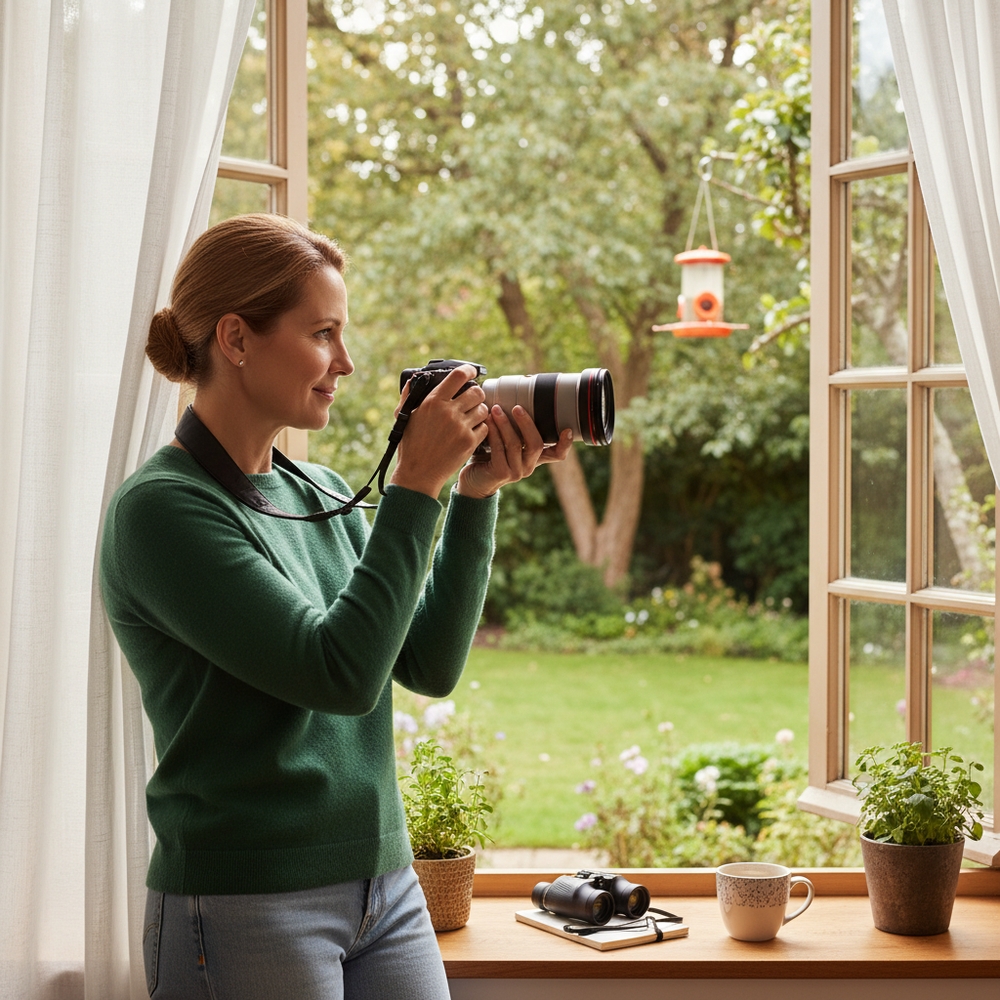
1. Shoot from the “Blind” Your house is the ultimate hunting blind. The best photos are often taken from inside, shooting through a clean kitchen window. The birds won’t see your sudden movements, allowing them to act naturally at the feeder.
2. Focus on the Eye A photo of a bird is only considered “good” if the eye is in sharp focus. Always place your camera’s autofocus point directly on the Oriole’s eye. If the tail feathers are slightly blurry, it’s fine, but the eye must be sharp to connect with the viewer.
3. Use a Monopod or Tripod When you are zoomed in to 600mm, the tiny natural shake of your hands is amplified into a massive earthquake on the camera sensor. If you are shooting from a patio chair, use a simple, inexpensive monopod to stabilize the camera.
Conclusion
Capturing the fleeting beauty of a Baltimore Oriole in a photograph is one of the most rewarding aspects of backyard birding. By upgrading from a smartphone to a dedicated “Superzoom” bridge camera like the Panasonic Lumix or Sony RX10, you gain the optical reach required to take stunning, high-resolution wildlife photos right from your own kitchen window.