Published
- 5 min read
The Mystery of the 'Yellow' Oriole: Identifying Females and Juveniles
The Mystery of the ‘Yellow’ Oriole: Identifying Females and Juveniles
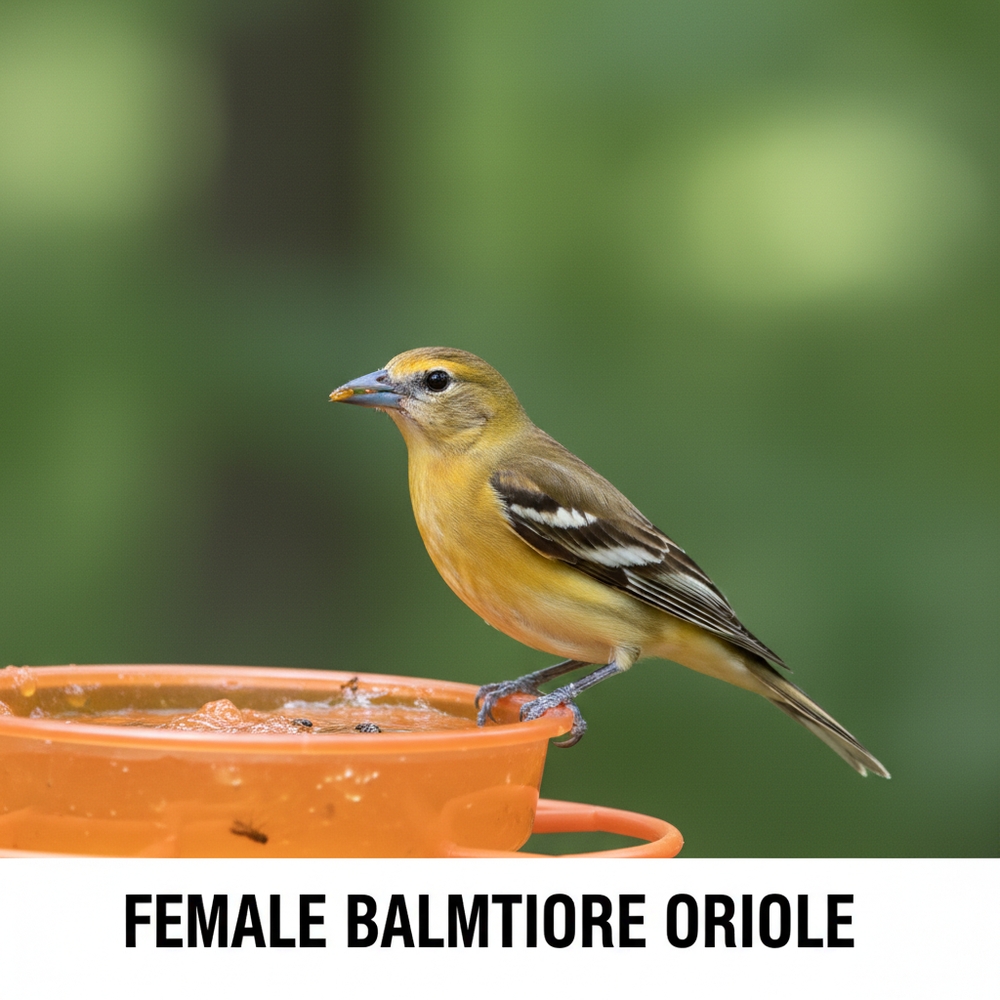
When you set up an Oriole feeder, you are waiting for a very specific image: the brilliant, flaming orange and jet-black male Baltimore Oriole. However, after a few days, you might notice a different bird frequenting your jelly cups. It is exactly the same size and shape as the male, and it eats with the same aggressive appetite, but its coloration is completely different. It is a muted, pale yellow-orange, with an olive-brown back and brownish wings.
Many beginner birders immediately assume they have attracted a different species—perhaps a large Goldfinch, a female Tanager, or some sort of oversized warbler.
In reality, you are looking at the other half of the Baltimore Oriole population: the Females and the Juveniles.
In the birding world, this difference in plumage between sexes is called “Sexual Dimorphism.” As a backyard birder, learning to identify these “yellow” Orioles is crucial for understanding the family dynamics playing out at your feeder. In this guide, I will show you exactly what to look for.
1. Why the Drastic Color Difference?
Nature is highly pragmatic. The male Baltimore Oriole is brightly colored because his job is to attract attention. He uses his neon orange plumage to advertise his genetic fitness to females and to defend his territory against rival males.
The female, however, has a much more dangerous job: she builds the nest and incubates the eggs. If she were bright orange, she would act as a neon target for hawks, jays, and raccoons while sitting in the tree canopy. Her muted, yellowish-olive coloring is perfect camouflage. When the sun filters through the green and yellow leaves of an oak or elm tree, she becomes virtually invisible to predators above.
2. Identifying the Female Baltimore Oriole
The plumage of a female Baltimore Oriole can vary wildly depending on her age.
- The First-Year Female: She is very pale. Her breast is a pale yellow to yellowish-orange, and her back is a drab grayish-brown. She has two distinct white wing bars.
- The Older Female: As female Orioles age, their plumage darkens and becomes more “masculine.” An older female will have a much deeper, burnt-orange breast. The most distinguishing feature of an older female is the development of black feathers on her head and face, sometimes looking like a messy, incomplete version of the male’s solid black hood.
The Key Identifiers: If you see a yellowish bird at your jelly feeder, look for these three things:
- The Beak: It should be long, sharply pointed, and silver/gray (not thick and conical like a finch or cardinal).
- The Wing Bars: Look for two distinct, stark white horizontal bars on the brownish/black wings.
- The Behavior: If it is aggressively defending the jelly cup and probing oranges, it is almost certainly a female Oriole.
3. Identifying the Juvenile (First-Year Male)
This is where identification gets tricky. In their first year of life, juvenile male Baltimore Orioles look almost exactly like adult females. They rely on the same camouflage to survive their first migration to Central America and back.
So, how do you tell the difference?
- The Fall Mix-Up: In late August, your feeders will likely be swarmed by these yellowish birds. Many of them are the juvenile offspring of the adults that nested in your yard. At this stage, it is nearly impossible to tell the young males from the young females without catching them in a net.
- The Spring Reveal: When they return the following spring, the one-year-old males will begin to show their true colors. They will still look mostly like females (yellowish-orange), but they will start developing patches of stark black on their throats and faces, and their orange will become much more vibrant than a female’s.
4. The Benefit of Binoculars
Trying to discern the subtle black throat patch of a first-year male or the aging hood of a senior female from 40 feet away is impossible with the naked eye. To truly engage in bird identification, you need proper optics.
- The Tool: A pair of 8x42 binoculars is the standard for backyard birding, providing the light-gathering capability needed to see subtle color variations in the shade of a tree.
- Affiliate Pick: Nikon ProStaff 3S 8x42 Binoculars
Conclusion
The bright orange males might be the star of the show, but the yellowish-olive females and juveniles are the true backbone of the Oriole population. By learning to identify the subtle variations in their plumage, you gain a deeper understanding of the life cycles and family dynamics happening right outside your window. Keep your binoculars handy, and appreciate the camouflage of the “Yellow” Oriole!